How Often Should You Retune Your Bass During Practice?
Tuning at the start of practice is smart. It is not always enough. A bass that sounded solid at minute 1 can drift by minute 20. Then lines can feel rough, chords can sound sour, and timing can feel less confident than it really is.
That is why a session-based tuning habit matters. Instead of thinking "tune once and forget it," it helps to think in checkpoints. Check before the first note, after a strong warm-up, after a big change in room noise or playing attack, and anytime the instrument starts feeling slightly off.
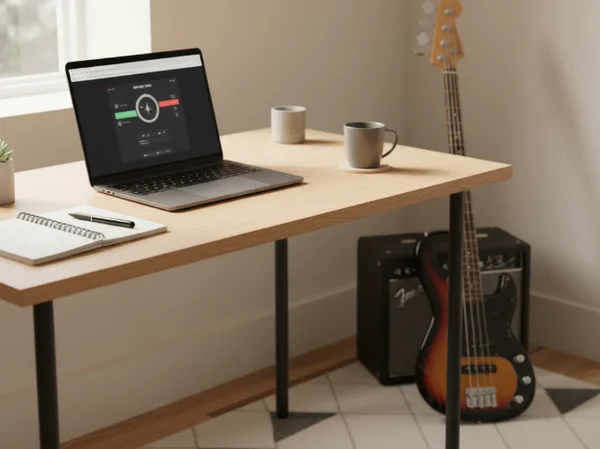
A fast online bass tuner is most useful when it becomes part of that rhythm. The site already keeps the tool, E-A-D-G basics, and FAQ on one page, so players can retune quickly without breaking the flow of practice.
Why Tuning Once at the Start Is Not Always Enough
Why does a bass drift during a session?
Strings settle as they warm up. Hands also play harder on some passages than others, and room conditions can make a note feel clearer or less stable from one minute to the next. Even when the bass is basically fine, a small drift can still matter if the session includes sustained notes, recording, or playing along with tracks.
That is why retuning should feel normal, not like a sign of bad gear. A quick check is often just part of playing accurately.
What Standard Tuning Gives You as a Reference Point
What are the 4-string E-A-D-G checkpoints to remember?
For a standard 4-string bass, the usual open-string targets are E1, A1, D2, and G2. A University of Central Florida reference chart lists those pitches at about 41.2 Hz, 55 Hz, 73.4 Hz, and 98 Hz (UCF frequency chart). That is the practical backbone of the site's bass tuning reference page: know the string order, then return to it quickly whenever the instrument starts to drift.
The goal is not to memorize physics before playing. It is to make sure each open string is back where it belongs before the drift becomes obvious in a riff or groove.
How much drift might your ear notice during practice?
The same UCF reference says the smallest pitch difference the human ear can usually notice is about 5 cents. That is useful because it explains why a bass can feel "almost right" and still bother you. Small changes do not always sound dramatic in isolation, but they can become distracting over a full practice block.
This is especially true when one string moves more than the others. The instrument may not sound wildly out of tune. It may just feel harder to trust.
The Moments When Retuning Matters Most
What should you check after warm-up, hard playing, or a long practice block?
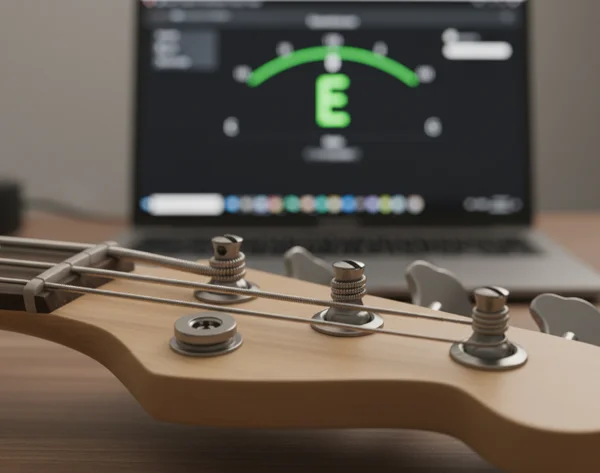
A simple rule is to check tuning after the first strong warm-up. Plucking harder, sliding more, or digging into repeated riffs can shift a string enough to matter. It also helps to recheck after any long section of focused practice, especially if you have been working on one string more than the others.
This does not mean pausing every 2 minutes. It means using short checkpoints: tune before the session, recheck after the first hard playing stretch, and check again whenever the sound starts feeling less centered.
What changes in noisy rooms or after a strong string attack?
A University of Alaska Fairbanks physics page lists the lowest open bass string as E at about 41.2 Hz and shows how strong harmonics shape what players hear while tuning (UAF bass acoustics page). In real life, that matters because noise, room reflections, and a heavy right hand can pull attention away from the clearest part of the pitch.
If the tuner seems inconsistent, change one thing before blaming the whole instrument. Pluck more evenly, mute unused strings, and tune one string at a time. In a noisy room, checking the lower strings twice can save time later.
Another useful checkpoint comes when you switch contexts inside the same practice session. A bass can feel fine during solo warm-ups and suddenly feel less centered once a backing track, drum loop, or metronome enters the picture. Retuning before that change can prevent the rest of the session from feeling harder than it should.
How to Use an Online Bass Tuner Faster During the Session
What is a simple retuning rhythm for beginners?
A good beginner rhythm is easy to remember:
- Check all 4 strings before starting.
- Recheck after the first warm-up block.
- Recheck after any obvious hard attack section.
- Recheck if a line suddenly feels harder to place in tune.
That routine keeps the browser bass tuner useful without turning practice into constant setup. It also teaches players to connect tuning checks with real moments in the session, not only with the start button.
When should you stop tuning and start checking setup instead?
If you retune, play for a minute, and immediately drift again, the issue may not be the tuning routine. Old strings, recent string changes, setup problems, or technique issues may be part of it. The site's quick bass tuner tool is best used as a checkpoint. If the same string keeps slipping, it may be time to inspect the bass rather than retune over and over.
It also helps to notice patterns instead of one-off frustration. If the bass settles after a quick retune, the normal practice rhythm is probably enough. If the same string keeps moving after every few minutes, that points to a hardware, string, or setup issue more than a tuner issue.
Next Steps: A Simple Rule for the Whole Session
What should you remember every time you practice?
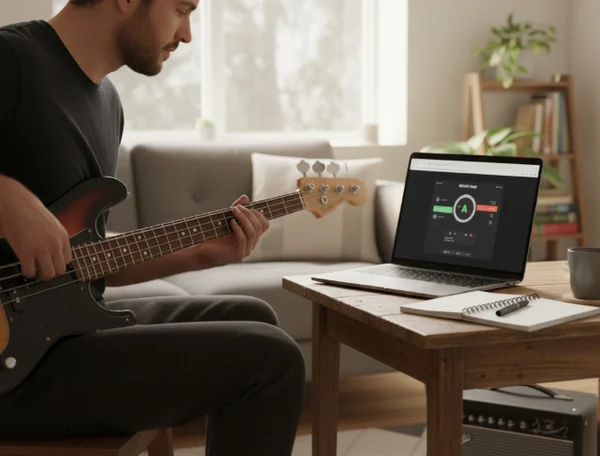
Tune before you start. Retune after the first real warm-up. Recheck whenever the bass starts feeling slightly unsteady. That rhythm is usually enough to keep practice honest without breaking concentration.
A bass that stays close to E-A-D-G throughout the session is easier to trust. And when tuning becomes a quick habit instead of a once-only chore, the rest of practice gets easier too.