Bass Tuning Science: Frequencies, Pitch & How Your Ear Works
Have you ever wondered why some notes sound "right" while others feel "off"? As bass players, we spend tons of time perfecting our tuning, but we rarely look at the science behind it. Whether you're just starting out or you've been gigging for years, understanding how sound works can really change your playing.
Nailing your tuning is the foundation of every great groove. But why is it so hard to get it right by ear alone? It all comes down to how sound waves travel and how our brains process them. By learning a bit about frequency and pitch perception, you'll become a much more precise musician.
In this guide, we’ll look at the tech behind modern gear and the physics of the bass guitar. If you want to get started right now, you can use our online bass tuner to see this science in action. Let’s jump into the world of low-end frequencies.
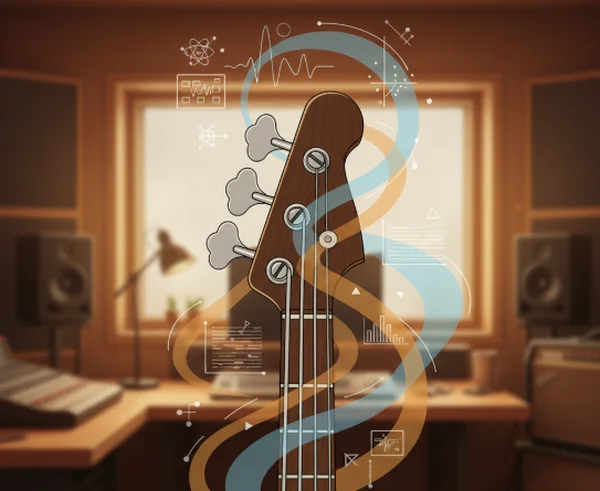
Understanding Sound: The Physics Behind Bass Notes
Sound is just a vibration moving through the air as a wave. When you pluck a string, it moves back and forth fast, creating pressure waves. These waves hit your eardrum, and your brain turns them into music. For us bass players, these waves are long and powerful. That’s why we often "feel" the bass in our chest just as much as we hear it.
The physics of these waves determines the note you hear. If the string vibrates faster, the note sounds higher. If it’s slower, the note is lower. Get this relationship down, and you'll be on your way to nailing the tuning every time you pick up your bass.
What Is Frequency and Why It Matters for Bass Tuning
Frequency is just a measure of how many times a sound wave repeats in one second. We measure this in Hertz (Hz). For instance, if a string vibrates 100 times per second, its frequency is 100 Hz. In the world of music, frequency and pitch are basically two sides of the same coin.
Bass frequencies are much lower than those of a standard guitar or a violin. This makes things tricky. Low-frequency waves are long, so it takes more time for a tuner—or your ear—to find the exact pitch. That’s why using a high-quality bass tuner is a lifesaver. It picks up those slow-moving waves way more accurately than you can in a loud room.
The Bass Guitar Frequency Chart: Standard Tuning in Numbers
To really know your instrument, you should know the specific numbers behind each string. In standard tuning (EADG), every string has a target frequency. This chart shows the "True Pitch" for a standard four-string bass:
- G String (Highest): 98.00 Hz
- D String: 73.42 Hz
- A String: 55.00 Hz
- E String (Lowest): 41.20 Hz
If you're playing a 5-string, that low B vibrates at a deep 30.87 Hz. At these levels, even a tiny change in tension shifts the frequency by several Hertz. That shift is what makes you sound out of tune. Digital tools help you hit these numbers without any of the guesswork.
How Your Ear Perceives Pitch: The Psychology of Accuracy
Our ears are pretty amazing, but they aren't perfect. Pitch perception is actually subjective. Two people might hear the same note differently depending on the room's acoustics or their hearing health. This is the "psychology" part of music.
As the bass player, you're responsible for the foundation of the band's sound. If you're slightly flat, the whole group sounds heavy and dull. If you're sharp, the music feels tense and "nervous." Understanding how we hear helps you avoid these common pitfalls.
Perfect Pitch vs. Relative Pitch: What You Need to Know
You've probably heard of "perfect pitch"—the rare ability to name a note without a reference point. Most of us use "relative pitch" instead. This is the ability to identify notes by comparing them to something else.
You can train your relative pitch. For example, you might use your open A string to help tune your D string. But even the best ears get tired or distracted by background noise. That's why pros rely on tech to check your tuning throughout a rehearsal or gig.
Why Notes Sound Right: The Role of Harmonics in Bass Tuning
When you pluck a string, you aren't just hearing one sound. You're hearing a "fundamental" frequency mixed with "harmonics" or overtones. These harmonics give your bass its unique character and that signature "growl."
Harmonics are mathematically linked to the main note. The first harmonic is exactly double the frequency. Our brains use these overtones to help spot the pitch. Sometimes old strings go "dead," losing their harmonics. When that happens, it's harder to tune because the signal isn't clear to your ear or your tuner.
Technology Meets Music: How Modern Bass Tuners Work
Back in the day, players used tuning forks or pianos to find their pitch. Today, we have digital tools that are incredibly precise. But how does a tuner actually work inside your phone or laptop? It uses a mix of hardware (your mic) and software (algorithms) to process sound in real-time.
When you use the tool on our site, your mic captures the string's vibration. The software then runs a "Fast Fourier Transform" (FFT). This complex formula breaks sound waves into individual frequencies. It identifies the loudest one, which is the pitch you're playing.
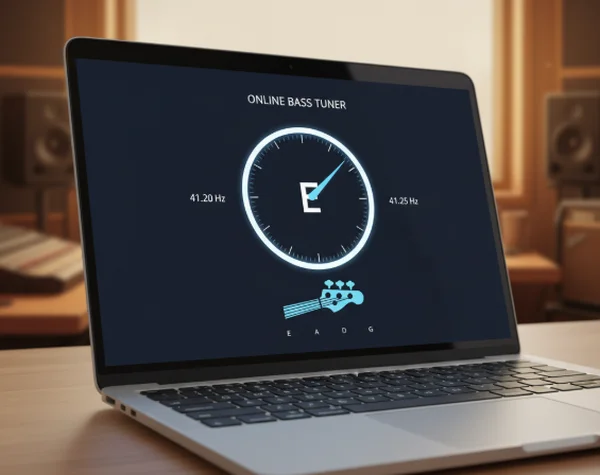
From Microphone to Meter: The Journey of an Online Bass Tuner
This all happens in milliseconds. First, the mic turns the physical sound wave into an electrical signal. Then, our code analyzes that signal to find the Hertz. Finally, you see a visual meter on your screen.
Our online tool uses a dual-interface system. Beginners can see a realistic headstock to know which string they’re hitting, while pros can use the high-precision dial. This visual feedback is way more reliable than human hearing because it doesn’t care about room echoes or ear fatigue. It’s your "source of truth."
Hz Explained: Why Digital Tuners Use Frequency
Digital tuners often show you "Hz" or "Cents." We know Hertz measures vibration speed. "Cents" measure the distance between two notes. There are 100 cents between each semi-tone (like E to F).
When we say a bass tuner Hz explained, we mean the tool is looking for the exact frequency. For example, 41.20 Hz for your E string. If the tuner says 41.50 Hz, you’re slightly "sharp." Digital tuners catch these tiny changes that your ears might miss, making sure you sound professional.
Beyond Basics: The Importance of Intonation on Bass Guitar
Sometimes you tune your open strings perfectly, but the bass still sounds "off" when you play higher up the neck. That’s usually an intonation issue. Intonation is just how accurate the pitch stays as you move up the frets.
If your intonation is out of whack, the physical length of the string doesn't match the musical scale. This happens a lot with "closet classics"—basses that haven't been played in years. Understanding the science of intonation helps you keep your gear in top shape.
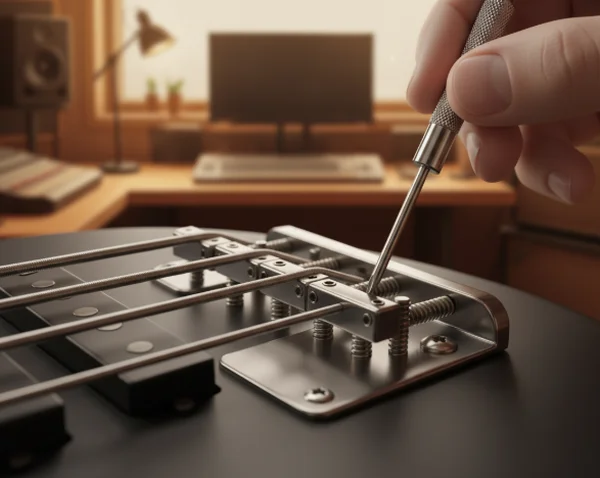
Signs Your Bass Needs an Intonation Adjustment
How do you know if your bass has an issue? It’s easy to test. Just follow these steps:
- Use an accurate tuner to tune your open E to exactly 41.20 Hz.
- Press down at the 12th fret and play the note.
- The 12th fret should be exactly one octave higher (82.40 Hz).
If the 12th fret is sharp or flat compared to the open string, your intonation adjustment bass settings need a tweak. You'll usually need to adjust the bridge saddles to change the string length.
Step-by-Step Guide to Setting Intonation
If your notes are out of tune up the neck, don't worry. You can fix most issues with a screwdriver and a tuner.
- Step 1: Tune the open string perfectly with a reliable online tuner.
- Step 2: Play the note at the 12th fret.
- Step 3: If the note is sharp, make the string longer. Move the saddle back (away from the neck).
- Step 4: If the note is flat, make the string shorter. Move the saddle forward (toward the neck).
- Step 5: Retune the open string and repeat until both are perfect.
The Science of Precision: Elevating Your Playing Through Understanding
When you really think about it, tuning isn't just something you do before practice. It's where physics, psychology, and modern technology come together to help you sound your best. Understanding your E string vibrates at 41.20 Hz and how harmonics affect your sound makes you more than just a player. You become a technician of your own tone.
Precision is what separates an amateur sound from a pro one. When your bass is perfectly in tune and properly intonated, your chords are clearer and your low-end feels tighter. Technology makes this easier than ever, so there's no reason to settle for "close enough."
Ready to put this science to work? Use our high-precision tools to get ready for your next session. Start tuning now and see the difference scientific accuracy makes for your music.
Frequently Asked Questions About Bass Tuning Science
Why does my bass sound out of tune when I play higher up the fretboard?
This is almost always an intonation issue. Even if your open strings are perfect, the bridge saddles might be in the wrong spot. This makes notes at higher frets sound sharp or flat. You can try this tuner to check your 12th-fret accuracy and see if you need an adjustment.
How accurate are online bass tuners compared to clip-on tuners?
Online tuners using the Web Audio API are extremely accurate. While clip-ons measure wood vibration, an online tuner analyzes the actual sound wave via microphone. In a quiet room, an online tool often gives a more precise Hz reading than a cheap clip-on.
What's the difference between cents and Hertz in tuning?
Hertz (Hz) is the absolute measure of how fast the string vibrates. Cents are a relative measure of the distance between two notes. Think of Hertz as your "speed" and Cents as how far you are from the bullseye. Most pros use cents to fine-tune their preferences.
Can I tune my bass with just my ears?
You can use your ears for "relative tuning," but finding "concert pitch" (A=440Hz) without a reference is tough. Room noise and ear fatigue make your ears unreliable. It's always best to use a digital tool to set your first string correctly, and then you can use your ears to check the rest if you want.